точка

пятница, 16 декабря 2011 г.

High Street Banks Deliver Best of Bad Service

One of the things most of us don’t change during our adult life is our bank. This has been proven to a certain extent, as two years ago the Office of Fair Trading discovered 64 per cent of consumers had always had the same account. As a result, many bank clients are finding both the rates not up to standard and faulty service.

A recent survey found that the new, smaller banks were offering better service overall, compared to the old high street bank names, most people are familiar with. About 43,000 people were surveyed about their experience with 31 leading banks and building institutions. The survey took things like current accounts, savings, mortgages and credit cards into account, to produce an overall satisfaction score.

High-street banks face break-up under commission plans

Retail and investment should be split, to avoid a future taxpayers' bailout, says finance chief
ritain's high-street banks may be broken up to protect taxpayers from future collapses, under radical plans being considered by the Independent Commission on Banking.

High street bank returns poised to fall


UK bank shares are likely to resemble those of low-growth utility companies if reforms proposed by the Independent Commission on Banking are implemented – but will still offer the prospect of rising dividends, analysts say.

New measures to ringfence bank’s high-street operations from their investment banking arms will be “game changing” and reduce total returns for shareholders, according to KPMG. “In many respects we are seeing a return to a more simple 1940/50s style of retail banking where it is perceived as more of a basic utility with low return on equity for shareholders,” said Jon Pain, co-head of the firm’s regulatory centre. “The really tough question is: can they generate earnings from the activities and services in the ringfenced bank that will provide a decent return?”

понедельник, 29 августа 2011 г.

High street banks 'over-charging' for will writing services.

By Myra Butterworth, Personal Finance Correspondent
High street banks have agreed to reform the way they sell will-writing and executor services following concerns that people do not understand the high costs of these services.

A survey by the Office of Fair Trading found that 43 per cent of people appointed their will-writer or solicitor as their executor – the individual who sorts out a person’s finances after they die.

Activists Occupy High Street Banks in UK.

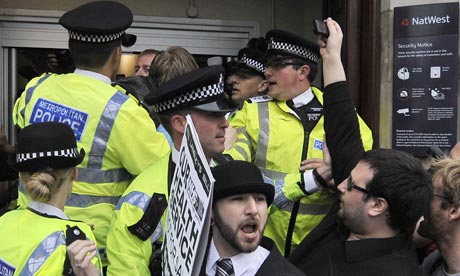
Protesters have been holding demonstrations outside high street banks around the UK and have succeeded in occupying a number of branches in the biggest direct action to date against proposed changes to the NHS.

The national protest, designed to draw attention to the banks' role in creating the deficit, is being spearheaded by the anti-austerity campaigning group UK Uncut, which has been were joined by trade unionists and others.

Activists dressed in doctors' coats and armed with fake blood had planned to enter branches and set up mock hospitals and "operating theatres". Instead they mostly staged their protests on the streets outside when branches were closed or police kept them out.

Lloyds Banking Group.

Lloyds Banking Group, Royal Bank of Scotland and HSBC are coming under pressure to follow Barclays after it said this week that it will compensate customers who were mis-sold payment protection insurancethousands of (PPI) on a no-quibble basis.

Barclays, which has set aside £1bn to cover the redress programme, said anyone who had complained on or before 20 April would have the complaint settled in full as a "gesture of goodwill". Peter Vicary-Smith, chief executive of consumer group Which?, called on the other banks to follow Barclays' lead.

понедельник, 23 мая 2011 г.

Bank of England.


The Bank of England is the central bank of the United Kingdom. Sometimes known as the 'Old Lady' of Threadneedle Street, the Bank was founded in 1694, nationalised on 1 March 1946, and gained independence in 1997. Standing at the centre of the UK's financial system, the Bank is committed to promoting and maintaining monetary and financial stability as its contribution to a healthy economy.


The Bank's roles and functions have evolved and changed over its three-hundred year history. Since its foundation, it has been the Government's banker and, since the late 18th century, it has been banker to the banking system more generally - the bankers' bank. As well as providing banking services to its customers, the Bank of England manages the UK's foreign exchange and gold reserves.

четверг, 10 марта 2011 г.

Yorkshire Bank

Yorkshire Bank is a commercial bank in England and Wales, a division of Clydesdale Bank, which in turn is a subsidiary of National Australia Bank. It mostly operates in the North of England, especially in Yorkshire. In 2006 underlying profit rose 16.7 per cent to £454 million compared with a year earlier, while post-tax earnings climbed 12.8 per cent to £229 million. Total income was up 8.7 per cent at £1,193 million while net interest income climbed 14.6 per cent to £769 million.

National Westminster Bank (NatWest)

National Westminster Bank Plc, commonly known as NatWest, is the largest retail and commercial bank in the United Kingdom and has been part of The Royal Bank of Scotland Group Plc since 2000. The Royal Bank of Scotland Group (RBS) is ranked as the second largest bank in the world by assets. It was established in 1968 by the merger of National Provincial Bank (established 1833 as National Provincial Bank of England) and Westminster Bank (established 1834 as London County and Westminster Bank). Traditionally considered one of the Big Four clearing banks, NatWest has a large network of 1,600 branches and 3,400 cash machines across Great Britain and offers 24-hour Actionline telephone and online banking services.

Lloyds TSB

Lloyds TSB Bank Plc is a retail bank in the United Kingdom. It was established in 1995 by the merger of Lloyds Bank, established in 1765 and traditionally considered one of the Big Four clearing banks, with the TSB Group which traces its origins to 1810. Lloyds TSB has an extensive network of branches and cash machines across England and Wales and offers 24-hour telephone and online banking services. Today it has 16 million personal customers and small business accounts. In Scotland, the bank operates as Lloyds TSB Scotland Plc.

HSBC

HSBC Holdings plc is a global financial services company headquartered in Canary Wharf, London, United Kingdom. As of 2010 it is the world's sixth-largest banking and financial services group and eighth-largest company according to a composite measure by Forbes magazine. It has around 8,000 offices in 91 countries and territories across Africa, Asia, Europe, North America and South America and around 100 million customers. As of 30 June 2010 it had total assets of $2.418 trillion, of which roughly half were in Europe, a quarter in the Americas and a quarter in Asia.

First Direct

First Direct (styled as first direct) is a telephone and internet-based retail bank in the United Kingdom, a division of HSBC Bank plc. First Direct has headquarters in Leeds, West Yorkshire, England, and has 1.16 million customers.

First Direct's tagline is "Black and white banking".

Citibank


Citibank, a major international bank, is the consumer banking arm of financial services giant Citigroup. Citibank was founded in 1812 as the City Bank of New York, laterFirst National City Bank of New York. As of March 2010, Citigroup is the third largest bank holding company in the United States by total assets, after Bank of Americaand JP Morgan Chase.

Barclays

Barclays PLC (LSE: BARC, NYSE: BCS) is a global financial services company headquartered in London, United Kingdom. As of 2010, it is the world's 10th-largest banking and financial services group and 21st-largest company according to a composite measure by Forbes magazine. It has operations in over 50 countries and territories across Africa, Asia, Europe, North America and South America and around 48 million customers. As of 30 June 2010 it had total assets of €1.94 trillion, the third-largest of any bank worldwide (after BNP Paribas and HSBC).

Alliance & Leicester

Alliance & Leicester was a former UK-based bank and PLC, which in later years operated as a trading name of Santander UK before being rebranded as Santander. Alliance & Leicester was legally acquired in May 2010 by Santander UK, and was fully incorporated by 2011.
Formed in 1985 through a merger of the Alliance Building Society and the Leicester Building Society, Alliance & Leicester became a bank in 1997 when it was floated on the London Stock Exchange. It was formerly listed in the FTSE 250 Index, having been a FTSE 100 constituent from April 1997 to June 2008.

Abbey National

Abbey National plc was a UK-based bank and former building society, which latterly traded under the Abbey brand name. It became a wholly owned subsidiary of Grupo Santander of Spain in 2004, and was rebranded as Santander in January 2010, forming Santander UK along with the savings business of the former Bradford & Bingley. Before the takeover, it was a constituent of the FTSE 100 Index.

The Co-operative Bank


The Co-operative Bank is a commercial bank in the United Kingdom and Guernsey, with its headquarters in Manchester.
The bank markets itself as an ethical bank, and refuses to invest in companies involved in the arms trade, global climate change, genetic engineering, animal testing and use of sweated labour as stated in its ethical policy. The ethical policy was introduced in 1992. In 2002, Co-operative Group Limited brought the bank and Co-operative Insurance Society under the control of a newly incorporated holding society, Co-operative Financial Services.